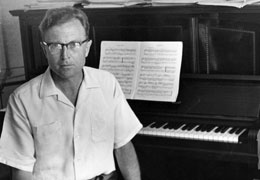
Douglas Lilburn


While visiting New Zealand in 1935 the eminent composer-pianist, Percy Grainger, announced a prize for an original New Zealand composition. Douglas won this prize with his tone poem for orchestra called Forest. In November 1935 Mr. Grainger recorded a brief talk [SA/NTK D-440] which was then broadcast by the New Zealand Broadcasting Board.

Forest was performed for the first time since 1937, on 28 May 2003 by the New Zealand Symphony Orchestra in the Wellington Town Hall, and broadcast live on Concert FM.

"The turning point I suppose was that Percy Grainger prize ... I was a third year student doing orchestration for the first time when I wrote this piece called Forest and put it in, and to my astonishment a few months later a reporter and a photographer turned up on the doorstep. After that it was fame. You know the sweet taste of fame, never had it so good since.

It gave me 25 pounds. What that was worth in those days I don't know, but it was enough to impress my family that there might be a bit of money in it you know. Not only that but my father had a letter from the President of the Farmers' Union congratulating him on his son's musical success. And I think it shook him a bit because he couldn't believe it. He used to say, if it had to be music couldn't it be the bagpipes!"

- Extract from Jack Body's interview with Douglas (ca 1980).


Opportunity for N.Z. Composers - Details of Competition Conceived by Grainger
N.Z. Radio Record - Friday April 17, 1936


At the suggestion of Mr. Percy Grainger, the eminent composer-pianist, who has donated the first prize of twenty-five pounds, the New Zealand Broadcasting Board is conducting a competition for a typical New Zealand musical composition. Second and third prizes of ten pounds and five pounds respectively, have been donated by the New Zealand Broadcasting Board, in addition to Mr. Grainger's first prize of twenty-five pounds, and entries are invited from all New Zealand-born musicians and others interested.

The following conditions have been laid down at the request of Percy Grainger:
  • The composer must be a born (not naturalised) New Zealander.

  • The composition to be between five minutes and thirty-five minutes in length.

  • The composition to be in any known or new musical style, and in any known or new musical form, and scored for any of the following combinations:

    • Six or more voices (vocal ensemble of solo voices or women's or children's chorus, or male chorus or mixed chorus, or solo voices with chorus), singing with or without words, with or without accompaniment by orchestral group (orchestra or chamber music or organ and instruments), or piano duet or two pianos. NB: Piano solo not permissible.

    • Chamber music for more than five, but not more than twenty-five instruments. Any combination of instruments may be employed, and a voice or voices (singing with or without words) may be used with the instruments if desired.

    • Orchestra of any size or combination of instruments (organ, piano, saxophones, etc, may be used as orchestral instruments).


  • The composition shall present typical New Zealand cultural and emotional characteristics. These may make themselves felt in a mood inspired by New Zealand nature in a patriotic background, in the use of Maori or other local traditional material in the development of "local colour", in the musical expression of the "national soul" in the celebration of a New Zealand city, in the celebration of a New Zealand rural mood, in the musical reflection of a New Zealand political point of view, or merely in the presentation of New Zealand moral and aesthetic ideals as applied to musical craftsmanship.

  • The adjudicator appointed by the Board will be an eminent musician not resident in New Zealand.

  • It is desired that competitors, if selecting words for a song, give preference to sentiments of a distinctive New Zealand character.

  • Entries must be received by the General Manager not later than twelve noon on July 31.

  • The following prizes are offered:

    • 1st prize, 25 pounds (donated by Mr. Percy Grainger)

    • 2nd prize, 10 pounds (donated by N.Z. Broadcasting Board)

    • 3rd prize, 5 pounds (donated by N.Z. Broadcasting Board)

A Bush Holiday Inspired Young Writer,
Full Results of Percy Grainger Competition for N.Z. Compositions
N.Z. Radio Record - Friday October 9, 1936


How would you like to take a delightful bush holiday and get twenty-five pounds for doing it? Sounds very attractive, of course, but there's really a good deal more to it than that. At any rate, it's happened, in a sense, to Mr. Douglas G. Lilburn, of 175 Cambridge Terrace, Christchurch, a 20-year-old musician, who has won the Percy Grainger competition for a New Zealand composer through his orchestra composition "Forest".

The "New Zealand Radio Record" had the pleasure of informing Mr. Lilburn of his success and congratulating him on his win. He was naturally very pleased but took the news quite calmly withal. He told the Christchurch representative of the "Radio Record" that he was born at Wanganui and started piano practice at the age of eleven. In Christchurch his teachers had been Messrs. Ernest Empson and Ernest Jenner. At the moment he is studying for the Mus.Bac. degree under Dr. J. C. Bradshaw, of Christchurch.

There's nothing of the musicianly pose about this young man. He is at present busy at Canterbury College, and hopes to complete at the end of this year, with England in view. "Forest", the winning composition, is, to use the young writer's own words, a "tone poem for orchestra," but, he says he is by no means satisfied with it yet. It took him eleven days to sketch out. He was on holidays at Peel Forest, South Canterbury - a favourite place for artists with pencil and brush - when he "got the idea", later to come under the eyes of the eminent overseas judge as prize-winner. His favourite composers are Bach, Beethoven, Sibelius and Brahms, but his views on modern music are interesting.

"Modern music," says Mr. Lilburn, "is in a state of extreme confusion, following a series of revolutionary movements in Europe. There's a good deal of value in all of them, of course, but there is much concentration on technique and not enough on musical content.

"What about hot rhythm? Well, Duke Ellington is streets ahead of George Gershwin, and is a real genius. There is no reason why any composer should not use any technical means as long as he is not merely exploiting them for their own sake."

"New Zealand," he considers, "does not have the opportunity of hearing enough good modern works and of judging them correctly. However, the radio is of the greatest possible value to young musicians, provided it is used properly. Moreover, New Zealand orchestras are greatly handicapped by lack of money for rehearsing."

The judge's official report on Mr. Lilburn's work states that he had no hesitation whatever in placing the entries in their order of merit. "I went first and foremost for quality of ideas", he says. "Craftsmanship had to be taken into account, too, and generally these two attributes (matter and manner of presentation) went together... The winning entry easily outshines its rivals on both points... I was delighted to notice the genuinely indigenous, patriotic and even truly democratic note in most of the works submitted, especially in the best of them - the more so as I know this is one of Mr. Grainger's paramount ideals."

Reporting more particularly on "Forest", the judge makes these remarks: "A loveable work. One example of many real gems of originality is the episode, pp. 2 to 8, beginning with all solo instruments, later merging into the 'tutti', striking and portentous, full of the intimate whispers of the forest; technically speaking, quite a marvel of both counterpoint and orchestration. The composer shows fine taste in his copious use of 'church modes' - in their expressive melodic qualities, their purity and austerity, ideal for his purposes. He has the power of sustaining a 'vast' sombre mood over many minutes, by his dark colours and the rare restraint of his quiet atmosphere.

"While this conveys the sense of 'immemorial' monotony suggested by this subject, he nevertheless holds the attention from bar to bar. Indeed, in his power to limn a mood and the general certainty of his orchestra touch, he is often reminiscent of Sibelius. His contrapuntal effects, full of suggestiveness and originality, achieve a peculiarly mysterious atmosphere at times" one might describe it as an effect of 'static motion'. His modern touches, one feels, are quite his own. A thoughtfully unified work whose contrasts are well ordered and whose climaxes are invariable broad and mighty and well worth while."

"What are you thinking of writing next?" the "Radio Record" representative asked.

"Well, I'm still merely a student, you know", was the reply, "and I have a lot to learn. In fact, I'm studying the art of writing fugues!"

How's that for modesty? Well I ask you!

Other Prizes


This competition was sponsored by that great apostle of free, unfettered self expression in music, Mr. Percy Grainger, who has presented the first prize. Further placed entries are as follows:

Second Prize, Ten pounds (presented by National Broadcasting Service): Miss Dorothy I. Johnston, Dunedin "The Noosing of the Sun Good" (A) (for chorus and orchestra); words by Miss Jessie Mackay.

Third Prize, Five pounds (presented by National Broadcasting Service): Miss A. Wilson, Dunedin "The Orphan Isles" (for chorus and orchestra); words by Mr. Robert J. Pope, Wellington.

Highly Commended: Mr. J.B. Durham, Palmerston North "The Noosing of the Sun God" (B) (for chorus and orchestra); words by Miss Jessie Mackay.

Highly Commended: Miss F.E. Polard, Christchurch "Twilight and the Mako Mako" (for soprano and chamber ensemble); words by Johannes C. Andersen.

Highly Commended: Mr. N.E. Stallard "Dawn in the Pelorus" (tone poem for chamber orchestra).

Commended: Miss R.E. Rowlandson, Auckland "Te Ika a Maui" (The Fishing of Maui) (for six solo voices and chamber ensemble); words by Miss B.E. Baughan.

The following are some quotations from the general report of the eminent overseas musical authority who acted as adjudicator: "and am glad to tell you that some of the best passages in several of these works gave me moments of real delight." Later he says, "I was delighted to notice the genuinely 'indigenous', patriotic and even truly democratic note in most the works submitted - especially in the best of them - the more so as I know that this is one of Mr. Grainger's paramount ideals."

Of the work placed second, "The Noosing of the Sun God" (A), he says: "A work of considerable power, showing, as far as the choral work goes, a ripe experience and almost unimpeachable taste... The whole work is carried through with a fine unity, as well as possessing a wealth of diversity."

The third prize winner is commented on as follows: "A work of good promise, showing many excellent features. The melodic lines are sound , often possessing real beauty."

Finally, the judge says, "I feel that I must say again how happy I have been to be associated with your competition. I congratulate you on having held it, and on the very tangible co-operation of that great musician, Mr. Percy Grainger. In working with him, you are doing incalculable good to the art, in the discovery and encouragement of talent that, possibly, might otherwise not be discovered until many years later, if at all."
 

About the Series         Audio         Images         Reference Material         Purchase         Credits         Contact