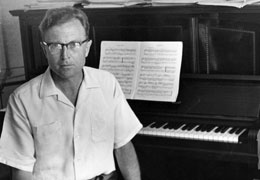
"If I had a novelist's ear and memory for words I would have ample material to write a biographical sketch of Douglas Lilburn. But I greatly mistrust my ability to reconstruct accurately from memory what is expressed during those fabulous boozy evenings. And so I decided to pay him a visit recently (ca 1980) with a tape recorder in my hand and treachery in my heart. I half expected to be turned away from the door, but Douglas suffered the machine, sitting hawk-like in his chair casting mean suspicious glances sideways at it. Occasionally he would swing over and switch it off, and I would have to wait for the chance to click it on again surreptitiously."
- Jack Body (extract from the 1980 Festschrift)
"I was the youngest child of seven. I arrived five years after a twin brother and sister, so there was quite a gap, and my eldest brother was seventeen years older than me. And when I was about seven years old my parents took my eldest sister with them and they went off on a grand tour as retired people did in those days with enormous trunks which Cooks looked after. My eldest brother had just married. His wife was someone whom I loved dearly - she was like a second mother to me and they were like second parents at that time - almost closer I imagine than my own parents in the sense that we would play tennis and go swimming together and picnic in the bush. But this was at the moment when my twin brother and sister were sent off to boarding school and so in fact I was left a single child in this house which had been full of people before and I kind of rattled around in it on my own apart from my brother and his wife and elderly housekeeper…
The farm was Drysdale Station which was at Pukeroa which is eighteen miles out of Hunterville on the upper reaches of the Turakina River, way back in the bush - a beautiful place, beautiful, beautiful, yes. I mean I just had this paradise to roam around in and there were some neighbourhood kids that I could play with. But there was a slight barrier there because they were the children of people who were working on the Station and always at a certain point they went back to the small houses and I went back to the big house. When my parents came back they moved into Wanganui to retire and they took me with them and I went to school there. But on holidays of course I always went straight back to one of the farms…
You know when you talk about the loneliness of childhood that I had at that particular time when my parents went off to England and my brothers and sisters disappeared… I remember the first time my brother and sister came back, and we played together again. The big dining-room table was made into a house with rugs hung over it, something like that, and we all got inside. This was fabulous. But then of course they went off and I was wandering round again, and tried to do it on my own. But I finished up in tears I think, with the realisation that one is alone, and that one can't repeat things like that. A very searing kind of experience in a sense. It's not a very big house now, but it was a very big house to me as a child.
You ask for significant times and places - but James Joyce tried to do it you know over one day. It's not possible. It needs an extraordinary art to know what to throw out. Even your admired Genet says this: "The problem of writing is not what you put in but what you throw out". That's absolutely true. I've got something to show you.
James Murray, [the compiler of the] the Oxford English Dictionary: "It is one of the hateful characteristics of a degenerate age that the idle world will not let the worker alone, accept his offering of work, and appraise it for itself, but must insist on turning him inside out and knowing all about him and really troubling itself a great deal more about his little peculiarities and personal pursuits, than his abiding work. I wish we knew nothing of Carlyle but his writings; I am thankful that we know so little of Chaucer and Shakespeare. I have persistently refused the whole buzzing swarm of biographers saying simply, "I am nobody. If you have anything to say about the dictionary, there it is at your will. But treat me as a solar myth, or an echo or an irrational quantity, or ignore me altogether." I read that this morning, anticipating you… It's a pruned tree which bears fruit, not the tree that grows luxuriously. That's an old saying. And the person who produces work is not necessarily an interesting person.
For me, teaching became easier when I finally began to realise that there was no real barrier between me and the people I was talking to, that I was talking to them as though I was arguing with myself, almost that we were a part of one thing. To try to involve them so that it becomes a two-way process essentially. I'm rather pleased when one of my students says to me this year, "You know you didn't hand us a line. You asked us to think." … Because there is not one truth, there are many truths, particularly about music. Everybody's ears are on different and nobody translates the messages which come through the ears in quite the same way and so one simply cannot - what's the word? Can't think of it now. Turn off that bloody machine.
You're asking me for some sort of time scale and this has always been confusing for me because my birthday comes at the end of the year on the second of November. I was born the second, eleven, fifteen. And to take another signpost, I went to Waitaki Boys' High School in the South Island in the 1930's, I would have just turned 14, and before that I would have had two years at St. George's Intermediate in Wanganui, and three years before that in the Friends' School on St John's Hill… I took the Proficiency Examination when I was eleven, and after two years at St George's Intermediate I went to Waitaki, where I was put into the Lower 5th form, and I matriculated the next year at the age of fifteen… In fact I matriculated very young…
Why was I sent to Waitaki? Before my family moved into Wanganui, all my brothers went to Wanganui Collegiate as boarders. I was never quite clear about this, but it probably would have been ignominious to have been sent to Collegiate as a dayboy: on the other hand my father was quite firm that he wouldn't send me there as a boarder and have me cycling home every weekend. And the alternative was to be shipped off to this unknown place in the South Island, which upset me very much at the time. They chose it because Frank Milner was a rabid Imperialist, a personality, and the school had a considerable reputation. And it was in a cold dry climate and this was supposed to be good for me because I had weak lungs … I thought it was an utterly barbarous place when I first hit it: you know I'd never been away from home before except to a member of the family. And suddenly to be slung into this arena of bullying little bastards - oh God, I hated them, and they hated me, especially because I was brainy. In the lower fifth I was a year or two younger than any of them, and in fact I gained higher marks in Matriculation that year than anyone else of the boarders, and the head prefect who had instigated an investigation, when he found that I had beaten his marks he was furious with me. Yes, and so were they all. And so, as I say I survived…
There I was. I'd been sent off to this remote place and I gained my Matriculation the first year and then I was in the sixth form and what was I to do? I was far too young to go to university and it was cheaper for the family to keep me there at boarding school. And so I did university courses extramurally from Otago. Of course this was disastrous because for two formative years I had no proper supervision or instruction. It was all very hapless. I did English I, History I, Economics I, French I. I think I sort of slopped through by memorising pages of Hamlet. At least I could quote most of the play from memory even if I didn't understand what it was all about. It was only when I got to Christchurch later - much, much later - and met up with Ngaio Marsh producing Hamlet that suddenly the play became alive, and I was able to cash in on the memory of it.
The reason why I was able to go to Christchurch was that I probably persuaded my parents that I might have a career in journalism or something. It was a sideline. I took the Principles and Practice of Journalism from someone who was editor of the old Sun I think, the evening newspaper. He cured me of wanting to work in journalism very quickly… In the meantime I'd waffled into the Music Department and gained high marks, so I began to switch. Oh yes, I was still learning the piano. When I was at Waitaki I'd been put with one of their three bumbling old men - he was impossible, and I then wanted to go to the person who I knew to be a good teacher, Kate Cartwright, who produced some distinguished pupils down there… but I wasn't allowed to go to her because she was a Catholic, and this seemed to me iniquitous. And so, happily, on Saturday afternoons, the football matches used to be played at the Athletic Park just down the railway line from the school, so we'd all charge down there to go to the football match, and I would charge on another hundred or two yards and have a music lesson with Kate Cartwright, and then join the crowd as they came back…
My first interest in composition - this happened in the middle of lunch at Waitaki. I had an idea in my head and I couldn't wait to get out of lunch to write it down. I just knew that I had to be a composer. Why it should happen in the middle of lunch no-one knows. But anyway that was the turning point.
And so she [Kate Cartwright] sent me on to her mentor, a very grand old piano teacher in Christchurch, Mr Empson, one of the best teachers ever… I went to Ernest Empson for a year, but alas he was feeling the economic pinch and he headed off to Australia. But meanwhile I pursued university courses. I think I completed the requirements for a Diploma of Journalism and for a Diploma of Music. I never actually wrote an Exercise, which had to be a work for chorus and orchestra, in order to complete a MusB. Despite the fact that I had won the Percy Grainger prize for an orchestral composition by a New Zealand composer against all comers I still wasn't eligible to qualify for a BMus degree! Nor even after I'd come back here and won three out of four of the Centennial prizes I still wasn't qualified to take out a BMus degree. So I thought to hell with that … and got on with being unemployed in Christchurch.
The turning point I suppose was that Percy Grainger prize … I was a third year student doing orchestration for the first time when I wrote this piece called Forest and put it in, and to my astonishment a few months later a reporter and a photographer turned up on the doorstep. After that it was fame. You know the sweet taste of fame, never had it so good since. It gave me 25 pounds. What that was worth in those days I don't know, but it was enough to impress my family that there might be a bit of money in it you know. Not only that but my father had a letter from the President of the Farmers' Union congratulating him on his son's musical success. And I think it shook him a bit because he couldn't believe it. He used to say, if it had to be music couldn't it be the bagpipes!…
Yes, my father agreed to send me to London to study on the strength of this Percy Grainger prize. He agreed to give me an allowance of three pounds a week, which wasn't lavish. And he gave me a two-berth cabin to go in because he thought his brother who might be in Auckland might come to see me off -I wasn't going to be seen off in anything less than a two-berth cabin. And so off I went in July '37. It took six weeks I think on the old Ruahine, and I arrived in London and got myself established somehow… I had roughly two-and-a-half years in London, two-and-three-quarter years I think. I studied piano, composition, orchestration, sixteenth century counterpoint, conducting, at the Royal College…
Other Students? Oh yes, I was very conscious in my final year at the College which was 1939 that Denis Dowling won the Tagore Medal for the best student in the college, operatic singer; that Cecilia Keeting from the West Coast was leading the first orchestra; that Alex Lindsay was very prominent violinist there; Colin Horsley was a premier pianist there; and that I won the Cobbett Prize for composition - and I thought for a couple of little islands way down under it was really pretty good.
And so I arrived home to find that I had won three out of four Centennial competitions. Was anybody in the universities, was anybody in my family impressed? Oh no! They more or less conveyed to me that I was still no good as a farmer -that if I had been any good as a musician I wouldn't have come home.
So bless them, I did a year on the farm in Taihape - my sister's farm because her husband had gone off to the war. That was an extraordinary experience. Sheep farming. Well, I arrived there in the pouring rain. I was dropped off at the gate and had to climb a hill lugging my suitcase… I was delegated to do the milking. I lived in a tin whare just across from the house. At six o'clock the alarm clock would go off and wake the girl who would pick up a piece of scrub and heave it at the roof of my whare. This was my signal. I'd get up and get dressed quickly and go round behind the Macrocarpa hedge and find these two old milk cows and stir them into life with a shoo. You know it took a good deal of tact and persuasion. I mean you had to wake them up and sort of get them up on their rheumatic knees and wait while they stretched their tails out and did their job and then they were ready to move off into the bail. You couldn't hurry any of this, and it was very instructive. I used to do the milking and then come in for breakfast. Then I used to catch my horse and ride round. I had about 800 ewes you know, expectant mothers to keep an eye on, and this used to take till about two o'clock in the afternoon, and get home to have a bit of lunch and then do odd jobs and cut firewood. I used to have to do awful things like kill a sheep for household use, or kill a sheep for dog tucker. I simply did this because it had to be done. But when I killed the last one before I came away I vowed I would never cut another animal's throat. Those unanswerable questions. On the other hand if you've seen animals dying from natural causes as I saw frequently on the farm you would think it an act of mercy to cut their throats quickly…
In the middle of that year I was invited by Broadcasting to come down and conduct the String Orchestra which Maurice Clare had formed, because Maurice had gone off to farm in Canterbury. And so I was guest conductor there for three months and then after that I went back to Christchurch and I was very lost… I just knew what I didn't want to do, and gradually I picked up the old Christchurch context I'd known and it was a very good one indeed. I did occasionally teach if anyone turned up on the doorstep who wanted a lesson. There was Gerald Christeller who would come for a singing lesson, or Gwyneth Brown for a harmony lesson, and that dear Maisy Kilkelly, my best ever student, who would come for a harmony lesson, would arrive in a taxi and rush in with a cheque and say I'm terribly busy I can't come today!
So I sort of survived in Christchurch for many years. I had a little bit of capital and I earned a bit. I did odd jobs for Broadcasting like arranging things for string orchestra, Mozart four-handers, occasional conducting of the 3YC orchestra, and I did press criticism. Oh yes, I enjoyed it, but I got to be the most hated person very quickly.
I was in Christchurch for about six years - '41 until '47. And my associations with the Caxton Press? This was all one thing. There were excellent people at the Caxton Press like Denis Glover and Leo Bensemann - other people like Lawrence Baigent, excellent painters like Rita Angus, poets like Allen Curnow. I mean it was very civilised context. I travelled very little. Occasionally to Dunedin which was an outpost, and once up to Auckland. And I was terribly disappointed to meet my gods up there like R.A.K. Mason and Frank Sargeson, and realise that they were not oracles at all. This was much later when Owen Jensen arranged for me to go up for the first Cambridge Summer School.
Contemporary European music, goodness yes. Christchurch was a very advanced outpost. Victor Peters of the harmonic Society gave one of the very early performances of Belshazzar's Feast and the Rio Grande of Constant Lambert. He was a terrific conductor. I remember I had to go along as critic to Elijah. I thought 'Mendelssohn, my God, what do I say about this!' but I was sitting on the edge of my seat as I listened to these Mendelssohn choruses as conducted by this Victor Peters… Well I heard my first Bartok, Bartok String Quartet No. 1 on a portable gramophone and I was absolutely baffled by the sound, mad mad mad sound you know. Stravinsky - I picked up very quickly the early works - the big ballet scores. One could listen to these and one would get something one understood even if one didn't get the whole message. He was much less a problem than Bartok, say.
Vaughan Williams had already, along with Stravinsky and Bartok, become a presence in Christchurch, I suppose through works like Wenlock Edge which were recorded early and which came out here. And the Tallis Fantasia which is, I think, an incredible piece of music, and history will look at this from many angles, but it is really a monumental piece.
Well, I just knew I wanted to study with this man. Why I'm not sure… When I first walked in [to the first lesson with Vaughan Williams in London, 1937] I found this big lumbering man wrapped up in tweeds and I'd heard he'd said 'Another wretched student wants to come to me!' Okay he agreed to take me on and I was second student in the afternoon. After he'd had lunch he yawned terrifically - but after the first term I found I was number two in the morning. I took that as a signal for courage. Oh he was an incredible personality. He wasn't clever. He didn't tell one a lot about technical things at all, but I could learn that from elsewhere. But he did convey the essence of a personality and this thing about integrity - he liked to say cut out all the bits you like best. You know this is paradox, but it conveys the message don't be clever, don't be silly, don't try to impress - search for what is valid in your intuition, your understanding, and go from that. Vaughan Williams didn't admit a grammar. He felt that musical manner should be inbred. As a teacher he trusted you to know exactly what you wanted to do, and how you wanted to do it, and his only concern was to see that you did it without a lot of superfluous notes… He was the last person to talk about his own music, and I suppose this made an impression on me too…
Yes, I may have considered staying in England, but even apart from the war I was very conscious before I ever went to England of Ian Milner, son the Rector at Waitaki, saying, "I write with spleen from another ruined summer; one remains a colonial speaking the same language." I took note of that. And when I go to England of course I could pass as English or Scottish or something without much trouble with my accent, but I was always conscious of this thing. And of course I met up with some exiles because there still were exiles - people like D'Arcy Cresswell, James Courage and finally Robin Hyde. We were having coffee with Inglis Gundry and Robin Hyde in an old Warners Coffee House… and something was said about New Zealand by Inglis and Robin Hyde went into a throw and said, "New Zealand New Zealand New Zealand"… And bless her of course. She committed suicide quite shortly afterwards, but that nostalgic cry remained in my memory…
But from then on there seemed to be no more exiles. It was taken considerably for granted that people should come back, and that they could exist here: that this is what they should do. And of course this was born in the early premonitions of the poets and painters of the 30's…
The opening of the Music Department here in Wellington was in 1946. But before that, quite long before that, some public-minded people in the University had set aside that music room as a good room for music and that they wanted a Music Department. And so in 1946 they appointed Freddy Page as Lecturer in Music and he came up and set the whole thing going. I wrote him a testimonial. In the following year about Easter I got a telegram to say will you come and help out? 250 pounds a year. Yes, that was pretty small, but it was enough to enable me to keep my room in Christchurch on and to move into a single room in Wellington and teach part-time. Spend a teaching term in Wellington and go to Christchurch as quickly as possible back to my context and my piano. And the same thing next year '48, except I made 300 pounds a year. They didn't pay my fares up and down or anything like they do for people now.
But in '49 they advertised a Lectureship and I was very hesitant to put in for this because I really didn't want to sever my ties with Canterbury. On the other hand I realised that most of my Canterbury context had evaporated and it was time to do something different. So I put in for the Lectureship and got it and that was 600 pounds a year. Not bad money in those days. Kept afloat in a single room at least, and so I lived in a variety of single rooms. And then I called in a bit of capital which my family had been sitting on all this time and bought myself a little place at Paekakariki. I used to spend hours travelling backwards and forwards. I owned a car in about 1954 for about two years, I can' t remember exactly, but I used to enjoy coming in on the train. The trip on the train left you absolutely free to think, to look out the window. But as soon as I got this car it meant absolute concentration on the road, on what you were doing, and okay, it was twice as quick but twice as dangerous too. Anyway I was quite happy to get rid of it when I went of to England in 1955. That was my first leave…
At this time in Wellington I wrote no criticism because I realised that this makes more enemies that friends. And conducting only once or twice. I conducted Alex Lindsay's string orchestra. I'd had a disastrous conducting experience once in Christchurch, I remember, for the Noel Newson memorial concert where a singer got out of place in the score and I couldn't get her back in place and that sort of precluded anything more in that field. But I did once conduct in Wellington for Alex Lindsay, just to put him through a Mozart concerto in the first part of the programme so that he could take over in the second half. I'm not naturally a performer, a conductor, not someone wanting to present myself on a platform, just not that. The exact opposite. I mean in childhood if someone arrived at the gate or at the front door one's first instinct was to retreat back and disappear into the bush. It was safer there. So…"
|
|
|